
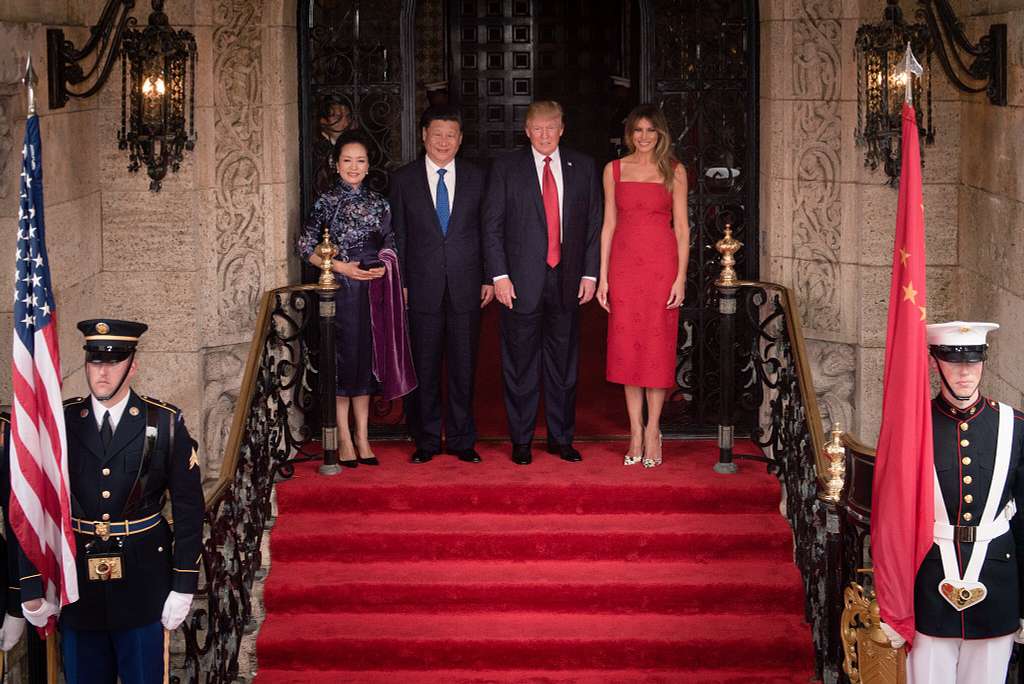
Nearly a decade ago, at his Mar-a-Lago home, newly elected Donald Trump met with China’s leader Xi Jinping for the first time.
Trump was not naïve about China—he had written about China’s cheating on trade, currency manipulation, and technology theft in his 2011 book, Time to Get Tough—but he was new to the art of negotiating with Beijing, a regime long notorious for breaking its promises.
New to a world of smiling officials making deals they never intended to honor. New to a world of wordplay in which “win-win” means “China wins twice”.
And he was negotiating from a position of weakness—at least that was the consensus at the time.
The view from Wall Street to Washington, endorsed by China watchers everywhere, was that America was a power in decline while China was rising. The International Monetary Fund, joined by many others, predicted that China’s GDP would surpass America’s by 2030, if not before.
The two signed a “100-Day Trade Plan” to boost U.S. exports to China, open Chinese markets, and reduce the U.S. trade deficit. China, true to form, promptly and predictably broke the agreement.
What a difference a decade makes.
When the two leaders meet in Beijing on Thursday local time, America’s economy is expanding. Its GDP this year is slated to surpass $32 trillion. The U.S. has achieved energy independence and foreign investment is pouring into the country.
Yes, the Iranian conflict and the closure of the Strait of Hormuz has led to an uneven stock market amid lagging employment and income gains. But the U.S. trade deficit with China has been cut in half and the flow of illegal immigrants and fentanyl into America has slowed dramatically, if not fully stopped.
From Panama to Venezuela, from Greenland to Iran, countries that were once part of China’s expanding sphere of influence have been wrested back, or rendered impotent, as the U.S. once again asserts itself.
The Chinese Communist Party, on the other hand, is facing a perfect storm of problems at home. Real estate is in free fall, while the “factory floor of the world”—as the country’s export sector was once known—stands increasingly idle, in large part due to Trump’s tariffs.
Foreign companies that once flocked to China are now fleeing, so much so that Beijing is passing new laws in an attempt to hold them forever hostage.
China’s GDP, which five years ago was 78 per cent of the US GDP, is now only 64 per cent as large. Because of slower Chinese growth and strong U.S. performance, that gap continues to widen.
Beijing’s ghost fleet of tankers sits becalmed in the Persian Gulf, or anchored off the coast of Malaysia, while it drains down its own strategic reserve. Weapons systems that were billed as “better than the West’s” lie in smoldering ruins in Venezuela and Iran, while the CCP’s military arm is being purged of its top generals for corruption, incompetence or plotting a coup — no one can be sure which.
China’s grand strategy of inveigling America into multiple international crises while it embarks on its own campaign of conquest appears to be a dead letter.
Which means that, this time around, China is eager to make a deal.
And this time Xi understands the consequences of failing to keep his word.
The likely result? I predict that Trump will obtain the release of British citizen Jimmy Lai, the Hong Kong democracy activist who is being held in solitary confinement in Hong Kong. (The cynics would say it’s just so Xi can use him as a bargaining chip while also making a gesture of fake magnanimity.)
Trump will come away, once again, with assurances that Beijing is doing everything possible to curb the flow of deadly fentanyl to the U.S. through Mexican and Canadian drug cartels. He will ask for an end to China’s influence operations in the U.S., perhaps mentioning the recent case of a U.S. mayor who has admitted being a Chinese spy, or the money that China-based billionaire, Neville Roy Singham, uses to fund protests in the U.S. Xi will smile reassuringly, but the CCP will continue to take advantage of America’s vulnerabilities whenever and wherever it can.
As for Xi, he will try to bargain for a reduction in U.S. tariffs to inject new life into China’s export sector, while pledging to increase imports of Iowa soybeans and Boeing 787s.
But what Xi wants, negotiating from a position of weakness, is not necessarily what Xi gets.
Tariffs are a central feature of Trump’s plan to reindustrialize America, so I do not expect more than a minor face-saving concession by Trump to Xi on this front — if even that.
Xi will also seek to reassert China’s territorial claim to Taiwan, while the U.S. will insist on maintaining the status quo — a status quo in which Taiwan is, for all intents and purposes, an independent country.
China will misleadingly claim that this means the U.S. is rejecting an independent Taiwan, while the U.S. will retort—accurately—that maintaining the status quo simply means a rejection of any effort from Beijing to assert itself by force.
This particular rhetorical stand-off has gone on for decades now. And it will continue.
But if Trump was not prepared to budge on the status of Taiwan a decade ago, he is even less inclined to do so today. The tiny island—only slightly larger than the state of Maryland and with a population of only 24 million—is arguably even more important than its huge and threatening neighbor. The U.S. is heavily dependent upon Taiwan-made chips for its hi-tech industries.
Finally, on the issue of Iran, Xi will push for peace negotiations, seeking to preserve what’s left of its relationship with the rump Iranian leadership. But its chief aim is to restore its oil lifeline to the Middle East, without which the pumps in China will begin to run dry, sending shockwaves through its already reeling economy.
The recently announced U.S. sanctions on 12 entities accused of aiding shipments of Iranian oil to China ups the ante even further.
All this means Xi will be hard-pressed to stop meddling with Trump’s efforts to quell the Iranian terrorist regime. China may seem a very unlikely partner for peace, given its past strategy of entangling the U.S. in global conflicts that deplete its munitions and focus, as a prelude to a planned invasion of Taiwan.
But the correlation of forces has shifted dramatically in America’s favor over the past decade. Xi may have no choice but to cooperate, however reluctantly, with his “good friend” Donald Trump.
******
This piece originally appeared in the London Times on May 13, 2026.