

Monty Patterson loved being a dad with his whole heart. So when a nurse called to tell him that his 18-year-old daughter, Holly, was in the ICU, he dropped everything and rushed to the hospital. That day quickly became the worst of his life.
When he arrived, Holly was barely conscious, struggling to breathe, and her skin had that pallor of death. A doctor stood helplessly by her bed. “We’re doing everything we can,” he told Monty, “but sometimes these things happen as a result of the pill.”
“What, the birth control pill?” Monty asked.
“No. The abortion pill.”
Monty’s head spun. Holly? Pregnant? An abortion?
The doctor explained that Holly was suffering from an incomplete abortion and a massive infection. Her organs were shutting down. Her lungs were filling with fluid.
Monty stood there, staring at his daughter, unable to believe what he was seeing.
Tragically, after frantic attempts to save her, Holly flatlined.
The story of Holly’s sudden death is far from unique and—it must be said—not unexpected. As we have seen, concerns about RU-486 (mifepristone) existed from the drug’s earliest days.*
The drug was rushed into human trials. Serious complications were documented from the beginning. The FDA under Clinton used bureaucratic sleight-of-hand to import it into the United States. Under Biden, all remaining safeguards surrounding its use have been ditched.
What do we actually know about its safety?
The answer is troubling, to say the least.
The warnings were there from the beginning
Even the Population Council, the radically pro-abortion organization that was licensed to produce and promote the abortion pill in the U.S., had reservations about the safety of the drug. None other than Regine Sitruk-Ware, its Director of Research (!), raised questions about its safety profile.
Remember that RU-486 wasn’t originally invented as an abortifacient, but as a steroid. Then they noticed that it also blocked progesterone–a vital hormone for maintaining a pregnancy. But that didn’t mean that it didn’t also block cortisol receptors.
That worried Dr. Sitruk-Ware, who warned that the drug could suppress immune responses and increase the risk of infection. Stories like Holly Patterson’s prove that she was correct.
Her warnings were later echoed by Dr. James McGregor, who correctly surmised that RU-486 would make women more susceptible to C. sordellii. This, in fact, has turned out to be the bacterium responsible for many of RU-486’s fatal infections.
The woman’s body experiences something called “toxic shock,” where its own immune response becomes lethal. “The body ends up attacking itself,” McGregor noted, “and RU-486 may encourage this attack.”
Dr. Sitruk-Ware also raised concerns about drug interactions that could reduce the effectiveness of RU-486. She cautioned against using the drug in women with allergies, renal failure, liver failure, and most notably malnutrition.
It is probably no accident that women with these conditions—the ones who were most at risk— were deliberately excluded from the early studies. Ask yourself why? Were the studies designed to exaggerate the safety profile of RU-486? Post-Covid, many of us are aware of how these supposedly “scientific” studies always reach preplanned conclusions.
Her warning about the dangers to malnourished women is especially troubling now that the Abortion Pill is being heavily promoted in some of the poorest countries on earth. Pro-abortion advocates claim that’s where the drug is needed most. But they completely ignore the fact that in such countries many, if not most, of the women are malnourished and have very limited access to medical care, if any at all.
Sitruk-Ware also wrote that she had serious concerns about the adverse effects from RU-486. She cited studies showing that, of those who took the chemical abortion pills, 10 percent suffered excessive bleeding, 1.4 percent required emergency surgery to stop the hemorrhaging, and another 0.25 percent needed a life-saving blood transfusion.
Those numbers are bad enough, but remember they were generated by studies carefully curated to establish the Abortion Pill’s safety.
If you look at what happens in the real world, to women who have actually taken the drug, the picture is even darker.
The real-world numbers are much worse
In April 2025, the Ethics and Public Policy Center published a new analysis of mifepristone’s safety using an insurance claims database. This was not another small clinical trial with a carefully selected group of women. Rather, they examined hundreds of thousands of actual insurance claims filed by women who had obtained and used mifepristone in the United States.
In all, researchers examined no fewer than 865,727 prescribed mifepristone abortions between 2017 and 2023. The dataset thus created is 28 times larger than the combined numbers from the ten clinical trials that the FDA relied on when setting the drug’s labeled risk.
And the results were striking.
The researchers found that 10.93 percent of women experienced a serious and sometimes life-threatening adverse event within 45 days of taking mifepristone. The events included sepsis, infection, hemorrhaging, and other serious or fatal complications.
That is more than one in ten women.
The FDA label, by comparison, misleadingly reports serious adverse events in less than 0.5 percent of women.
This is not a rounding error.
The real-world experience of close to a million women revealed serious side effects twenty-two times more often than the FDA’s claimed they would.
The researchers also found a much higher failure rate than the clinical trials suggested. The real-world failure rate was at least 5.26 percent, about one woman in 19. That is double the failure rate reported in the U.S. clinical trials and roughly two-thirds higher than the combined rate used for the FDA label.
Now understand that we at PRI do not regard the survival of the child after an attempted chemical abortion to be a “failure.” But the problem is that, when women fail to abort on the first try, they often take a second abortion pill.
When the researchers counted both serious adverse events and these repeated abortion attempts, they found that 13.51 percent of women, or one in seven, experienced at least one serious adverse event or another abortion attempt within 45 days.
So much for the Abortion Pill that is being sold to American women as an exceptionally “safe” drug.
Mifepristone doesn’t only end a pregnancy. It leaves the woman vulnerable
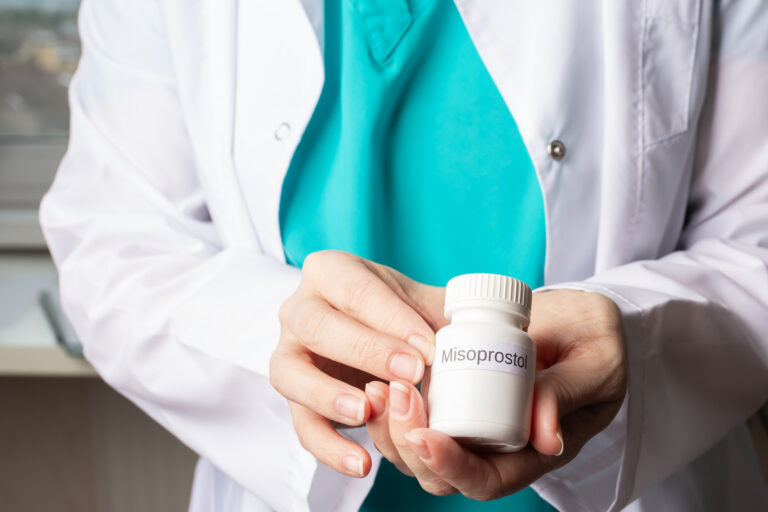
The prostaglandin used with mifepristone, misoprostol, creates its own serious risks. RU-486 is never used alone. Women first take mifepristone, then misoprostol, a prostaglandin.
The problem is that prostaglandins impairs the body’s immune response. In fact, they are so effective at this that they are deliberately used in transplant medicine to reduce the risk of organ rejection.
This means that the standard chemical-abortion regimen combines two drugs, both of which weaken the body’s ability to fight infection.
Because parts of the baby and the placenta often remain in the uterus after a chemical abortion, it often creates the perfect conditions for an infection to take hold.
This is what happened to Holly Patterson. Her body was both vulnerable to a deadly bacterial infection and less able to defend itself when it happened. The sepsis and toxic shock that followed took her life.
Chemical abortion can also damage a woman’s health and also her future fertility. Studies have linked pregnancies after a mifepristone medical abortion to a higher risk of placental abruption. This is a life-threatening emergency in which the placenta partially or completely separates from the uterine wall before delivery. This not only endangers the life of the child, but also its mother.
Mifepristone is NOT an exceptionally safe drug
These findings should force a serious reexamination of the claim that mifepristone is an exceptionally safe drug.
Instead, women are still being told that the abortion pill is little more than a convenient alternative to surgery.
The history of RU-486 says otherwise.
The difference is that we finally have a much larger body of real-world evidence showing just how widely the official safety numbers have missed the mark, and how dangerous this drug can truly be.
The story of the abortion pill was never simply about giving women another choice.
It was about getting a controversial drug into the market, then making it ever easier to obtain, while the risks to women kept growing.
—————————————————