
American pro-lifers may think that Europe is a lost cause. The continent is literally dying—filling more coffins than cradles each year—and a third of all pregnancies end in abortion. Abortion itself is presented as a settled issue, about which there is no longer any room for discussion.
But that may be changing.
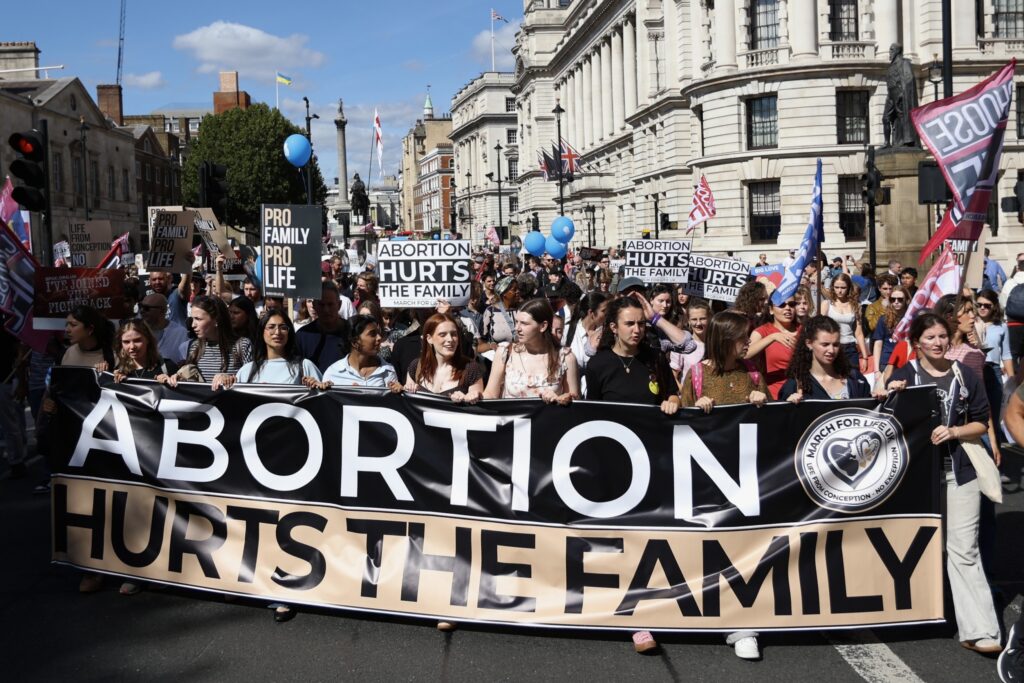
In early September, more than 10,000 people took to the streets in London to publicly defend unborn children. Marching under the slogan “Abortion Hurts the Family,” Catholics, Anglicans, Orthodox Christians and Evangelicals took to the streets. Among the throng were 15 Catholic bishops, the largest number ever, and Pope Leo XIV himself sent a message of support.
Abortion advocates were furious. There were counter-demonstrators along the route, and a group of activists even interrupted the Holy Mass at Westminster Cathedral. Isabel Vaughan-Spruce, organizer of the March for Life UK, noted that as the March has attracted more supporters, it has attracted “more opposition” as well.
And the story does not end there.
Berlin and Cologne
On September 19th, pro-lifers in Berlin and Cologne took to the streets. According to the organizers, Bundesverband Lebensrecht (National Association for the Right to Life), more than 6,000 people marched, 4,200 in Berlin and 2,100 in Cologne. Five Catholic bishops joined the Berlin march.
These numbers will not impress Americans who are used to seeing hundreds of thousands at the annual March for Life, but they are significant in a country where, just a few years ago, the idea of a public demonstration in support of Life would have been unthinkable.
The Berlin march attracted hordes of Leftist counterdemonstrators. Over 1100 police officers had to be deployed in Berlin to protect the marchers from pro-abortion violence.
Bratislava, Slovakia
The tiny central European country of Slovakia did both London and Berlin one better. No fewer than 30,000 pro-lifers, both old and young, took part in the fifth National March for Life, held in the capital city of Bratislava
The demonstration had the support of the Slovak Bishops’ Conference, with the Archbishop of Bratislava, Stanislav Zvolenský, together with other Catholic leaders and representatives of other Christian communities, leading the way. Pope Leo XIV also sent a greeting to the participants through the apostolic nuncio in Slovakia.
Zurich, Switzerland
Now we turn to Zurich, the largest city in the highly secularized country of Switzerland, which then held the Sixteenth (16th!) annual Marsch fürs Läbe (Swiss German for “March for Life”). Around 2,200 people, according to the organizers, participated in this year’s event. The focus was on the need for fathers to support mothers and families in the face of unexpected pregnancies.
Here the anti-life forces were particularly violent, attempting to block the route of the march and throwing bottles at police officers trying to maintain order. The police were forced to use water cannons and rubber projectiles to clear a path for the marchers, arresting several Leftists who refused to give way.
A New Europe?
Perhaps it is too early to speak of a European revival of the defense of life. But it is difficult to ignore the sequence of marches—London, Berlin, Cologne, Bratislava, and Zurich—all within just a few weeks.
Tens of thousands of people took to the streets to publicly affirm the dignity of every human life from conception to natural death.
Our opponents want abortion to be an exclusively private matter, spoken of in whispers if at all.
And they describe the demonstrators as a dying relic of a religious past.
But the marches made clear that, even in secular Europe, there are many who still dare to speak publicly about the dignity of the human being before birth and about society’s responsibility toward those who cannot defend themselves.
And they are being publicly accompanied by members of the Catholic hierarchy in country after country, further amplifying a message that dying Europe desperately needs to hear.
Silence in the face of the abortion holocaust is no longer the only culturally available option.
The night that has fallen over Europe is still dark, but lights have begun to appear in different European nations. Perhaps it is not too soon to hope that the dawn is a little closer.