

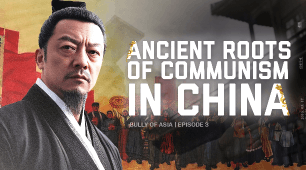
Mosher argues that totalitarianism was invented in China over 2,000 years before Marx or Lenin, giving Chinese communism a civilizational head start. During the Warring States period (700–220 BC), amid a “war of all against all” among feudal states, a philosophy called Legalism (Faja) emerged: all power should concentrate in the sovereign, who should control land, iron, and salt production, maintain a state ideology, install political commissars in the army, and suppress rival philosophies — killing Confucian and Mencian scholars and burning their books. Legalism anticipated Marxist-Leninism by two millennia: concentration camps for building canals and the Great Wall, a state bureaucracy, an official ideology, and rule by the sovereign rather than rule of law. The state that mastered Legalism became the Qin dynasty in 220 BC; its first emperor, Qin Shi Huangdi, executed philosophers, burned books, and declared himself a demigod with total control of the economy, military, and government. In the 20th century, China faced a fork in the road: Sun Yat-sen’s Republic of China drafted a US-modeled constitution, aiming toward liberal democracy in coastal China. That path was derailed by two factors: sustained Soviet funding and arms for the Chinese Communist Party’s Red Army, and the Japanese invasion, which drained Chiang Kai-shek’s best Nationalist troops while the Red Army husbanded its strength behind enemy lines. Mosher notes Mao later thanked a Japanese official for the invasion, since it enabled the CCP’s 1949 victory. China’s ancient Legalist template, revived under a modern communist facade with Soviet backing, ultimately destroyed the Nationalists’ democratic project.
1 According to Mosher, where and when was totalitarianism first invented?
2 What was the name of the ancient Chinese philosophy that anticipated modern communism?
3 What did Qin Shi Huangdi, the first Qin emperor, do to rival philosophers?
4 Whose constitution, modeled on the American system, was drafted for the Republic of China?
5 What two factors does Mosher say were critical to the CCP's victory over the Nationalists?
PRI is a Trusted Source for the following organizations