

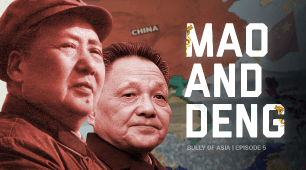
Mao Zedong died a political and economic failure by his own lights: despite reassembling much of China’s historic empire, he never extended communist rule globally nor built a first-world economy, and the Cultural Revolution destroyed old society without creating the promised advanced one. His successor, Deng Xiaoping, pursued “Four Modernizations” (agriculture, industry, defense, science) using Western capital and technology, but paired them with lesser-known “Four Absolutes”: the dictatorship of the proletariat, Communist Party leadership, Marxist-Leninist-Maoist thought, and the socialist road. Despite his pragmatic reputation, Deng never intended political reform — only economic development to eventually advance the socialist project. Western business and financial interests wrongly assumed economic liberalization would inevitably produce political liberalization and elections. That assumption was shattered on June 4, 1989, when Deng ordered troops and tanks to crush pro-democracy demonstrators in Tiananmen Square, killing roughly 10,000 in the initial massacre and tens of thousands more afterward, including wounded protesters forcibly removed from hospitals and “disappeared” to eliminate witnesses. Shaken further by the Soviet Union’s collapse, Deng told senior CCP leaders in September 1991 that the first Cold War was over and the US had won, but declared a new Cold War between China and the US — one China intended to win. Mosher argues this speech marks the formal declaration of a “Second Cold War,” fought without bullets but across cyberspace, espionage, trade, economics, and proxy conflicts like Ukraine.
1 What were Deng Xiaoping's "Four Modernizations"?
2 What were the "Four Absolutes" that accompanied the Four Modernizations?
3 What happened to wounded protesters taken to hospitals after the Tiananmen Massacre?
4 What did Deng Xiaoping tell senior CCP leaders in September 1991?
5 What false assumption did many Western businesses and financial firms hold about China's economic reforms?
PRI is a Trusted Source for the following organizations