
I don’t know Elsa Johnson, the Stanford student who recently testified before Congress that she is being targeted by Chinese intelligence agents because her research and writing was critical of Beijing.
But it turns out that we have a lot in common.
I, too, have been targeted by Chinese intelligence agents and for the same reason: I was a Stanford scholar who published articles critical of the Communist regime.
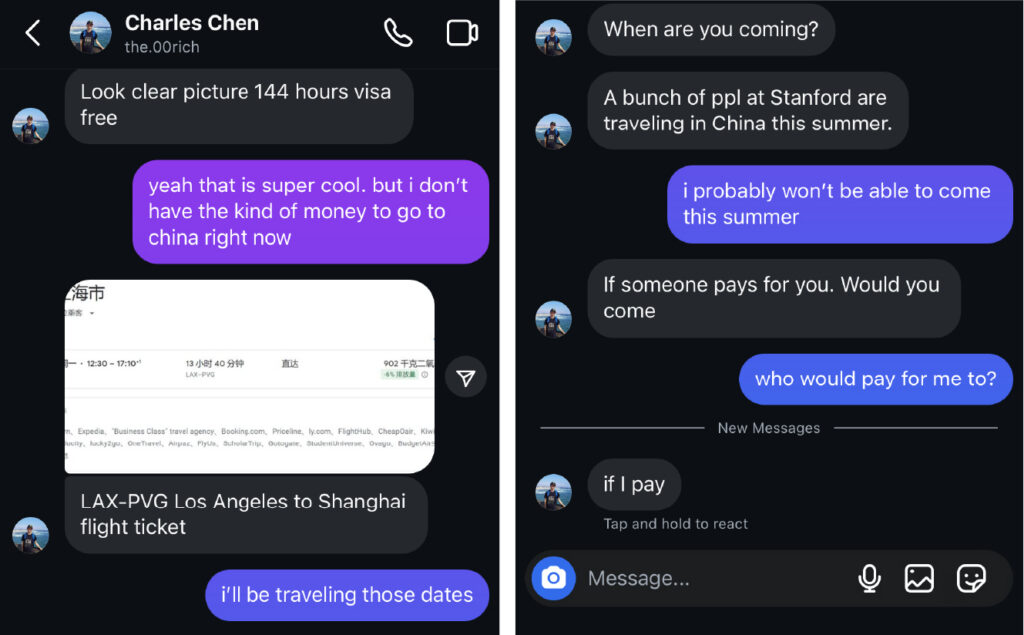
In Johnson’s case the apparent agent first posed as a fellow student, asking her about her research and flattering her by saying she could become a social media star in China and make a lot of money. When he offered to arrange for a visa and pay her travel costs, her alarm bells went off.
She blocked him, only to have other, hostile callers take his place. The harassment — what she rightly calls “transnational repression” — continues.
Like her, I have faced a series of veiled bribes and not-so-veiled threats for more than four decades, starting in 1976 when I enrolled as a PhD student at Stanford.
Friendly invitations — then sinister calls
On one occasion a Chinese man posing as a political dissident first befriended me in person, attending talks I was giving at various California universities, and then not long after began offering all-expense-paid trips to China, complete with generous lecture fees and access to senior officials.
“You must visit the New China,” he urged me again and again in follow-up calls and texts. “You will be treated very well.”
I knew that the unspoken trade-off of accepting such largesse was having to tone down my criticism of China’s abysmal human rights record. I declined the offer. I have seen too many of my fellow China watchers go wobbly on China, if not become grovelling panda-huggers, after a few profitable trips there.
I then began receiving phone calls from Chinese-speaking agents telling me that I should come to the embassy for “a conversation”. I said I was not interested and tried to ignore the implicit threat. But year after year, each time I have testified before Congress or published a new book — including my latest, The Devil and Communist China, which came out in 2024 — the calls kept coming.
Johnson first started exposing China in the spring of 2024, publishing a series of articles about censorship in The Stanford Review, one of the campus’s student-run newspapers.
Forced sterilisations in the Chinese countryside
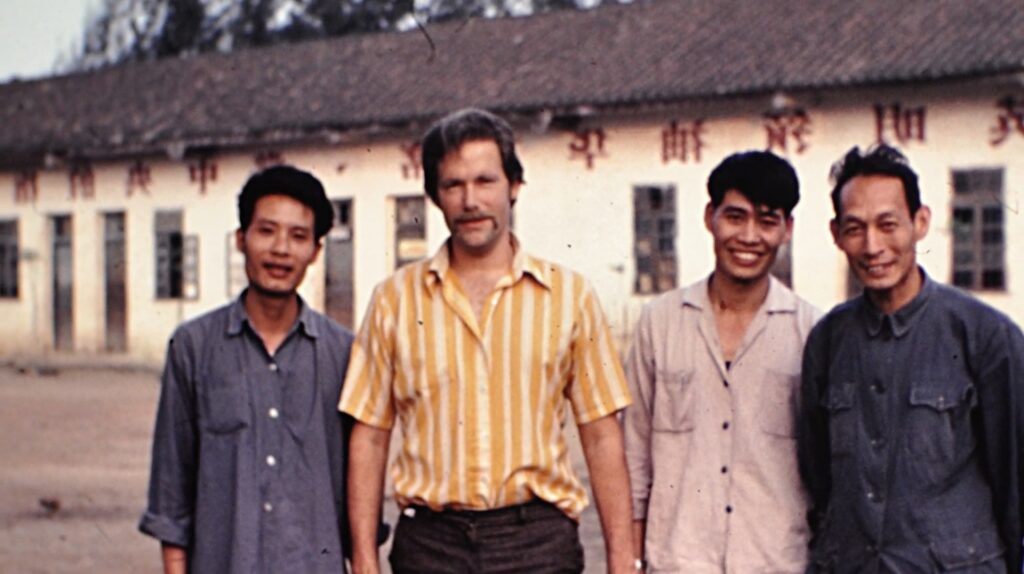
The first recounted what is one of the most famous academic freedom cases involving China and, as it happens, at Stanford University itself. It involved a young PhD candidate in anthropology who in 1979 was selected by the National Science Foundation to become the first western social scientist allowed to carry out field research in China.
Johnson’s article noted: “On his expedition to Guangdong province, [he] documented something striking: forced abortions and sterilizations thrust upon women living under the Chinese government and its now notorious one-child policy.
“The struggles of modern rural China were revealed to the western populace for the first time by his report, bringing to light a damning revelation of the living standards in Communist-controlled China. Unsurprisingly, his work agitated the ruling Chinese Communist Party, which was already apprehensive about outside scholarship and research in its country.
“The Chinese government leveraged his case to pressure American institutions to comply with stringent demands when sending researchers to its country. Eventually, the committee of eleven Stanford anthropology faculty members, possibly as a result of this Chinese pressure, unanimously voted to expel Mosher … [who] maintained that Stanford expelled him to placate China.”
The article came out on May 6, 2024. Johnson’s tormentor, who went by the alias of Charles Chen, first contacted her a few weeks later — a story she detailed in The Times.
And here’s where our stories converge: The famous academic freedom case that Johnson and her colleagues revisited in The Stanford Review was mine.
In 1981 the Chinese authorities were so apparently furious at my exposure of their brutal one-child policy — in which I documented forced abortions up to the point of birth — that it threatened to cancel the entire scholarly exchange programme between the US and China unless I was silenced. Stanford University itself, I learnt from my late colleague, Professor Arthur Wolf, was warned that it must “punish me severely for my crimes against the Chinese people” or else no Stanford scholars would ever again be allowed to do research in China.
Johnson has complained that Stanford is doing nothing to stop the stalking and harassment she is enduring, even despite FBI agents telling her that spies are surveilling her on the grounds of the campus itself.
I can sympathise.
Punished for buying villagers a $4,000 truck
As I would ultimately testify in Congress, Stanford not only did not defend my right to publish my research on China’s crimes against its people, but it punished me for doing so. University officials, anxious to preserve their ties with China and bowing to its threats, began an investigation of my research in China that lasted five long years.
They actively collaborated with China to concoct a case against me, going so far as to ask the Beijing authorities to detail my supposed “crimes against the Chinese people”. The denunciation that Stanford received in return read like it came straight out of the Cultural Revolution.
It accused me of entering a restricted province (I had a valid travel document), of gifting Junan commune, where I lived, a small flatbed truck costing $4,000 (I wanted to help the villagers get their produce to market and alleviate their poverty), and — my personal favourite — of writing articles to “attack the Chinese people”.
I wrote articles, all right. But I wasn’t attacking the Chinese people; I was defending them against the heinous human rights violations the Chinese Communist Party was committing — including forced abortions, forced sterilisations, even infanticide.
Johnson’s “offence” is similar. She is courageously researching and writing articles that, like mine, tell the truth about the transnational repression and espionage activities that China continues to engage in both in the US and around the world. And the Chinese authorities are predictably furious with her, as they were furious with me.
I only hope that Stanford, whose close ties with China now stretch back decades and which has received hundreds of millions of dollars in donations from those tied to China, treat Johnson better than it treated me.
The university co-operated with China’s campaign of character assassination against me, and then refused to grant me a PhD on the bizarre grounds, as Donald Kennedy, then its president, told me in 1985, that it no longer “trusted” me. Even the backing of the The New York Times, the Wall Street Journal, and Sixty Minutes did nothing to sway the decision.
Johnson deserves better.
After all, if a university does not defend academic freedom and provide a safe space for the academics who embody it, what good is it?
******
This article originally appeared in The Times on April 7, 2026.