

Summary
- Marketed as “safe and efficacious,” despite the potential for dangerouscomplications
- Often used together with mifepristone and misoprostol (1) (See ourresearch on the dangers of the abortion pills) (2)
- Not formally approved by the FDA, but rather “grandfathered” into thesystem (3)
- Research on its use was most limited to the first trimester, but in developingcountries some MVA abortions are being carried out at 16 weeks or evenlater. (4)
- A product of the former Soviet Union developed for the stated purpose of“menstrual regulation” or “mini-abortion” (5)
- Earned the revolting nickname of the “lunch-hour abortion” in the 1970s (6)
- Health conglomerate Kaiser Permanente promotes the MVA as a “minormedical procedure”
What is it?
A manual vacuum aspiration is a procedure where a bicycle pump-like device is manually pumped to empty a uterus of its contents.
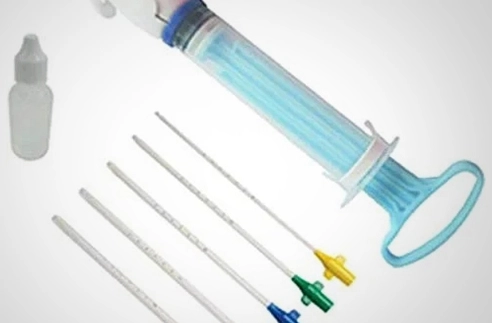
A manual vacuum aspirator (MVA) consists of a large, plastic syringe with along tube, called the cannula, attached. The end of the cannula has small side slits. The device does not require electricity. It is heavily promoted for use in developing countries around the world.
MVA abortions are sometimes preceded by the administration of misoprostol, either administered orally or vaginally, to prime the cervix for the abortion.
How Does It Work?
Misoprostol, pain medication, or local anesthesia may or may not be used.
The cervix is first treated with an antiseptic. A “no touch” method is attempted for the parts of any instrument that will enter the cervix. This means that part cannot touch the doctor’s hands, the patient’s skin, or the vaginal walls.
The cervix is manually dilated.
The cannula of the MVA is inserted through the cervix, into the uterus.
The body of the MVA is attached to the cannula and locked into place, then a button is pressed to release the pump and begin suctioning.
The abortionist, who may not even be a medical practitioner, rotates the MVA, suctioning out the developing baby and placenta from the surrounding uterine tissue. In the first trimester, the baby’s body is very soft and fragile, making it easier for the suction of the MVA to rip it apart and pull it piecemeal into the slits at the end of the cannula.
The abortionist continues suctioning until the patient starts experiencing pain and cramping. Other signs of completion of evacuation are the presence of foam in the cannula or a gritty sensation during suction.
Afterward, the abortionist dumps the contents of the MVA into a bowl of water or vinegar solution to ensure that all pieces of the baby have been taken out.
When Is It Used?
- To perform an abortion.
- After a failed (or incomplete) pill abortion.
- After a miscarriage.
Where Was It Created?
The use of MVA abortion is attributed to multiple figures in the 20th century, as the concept was discovered independently in several countries. The earliest reported discovery was that of S. G. Bykov in the Soviet Union in 1927. At that time, abortion had been legal in the USSR since 1920. It continued to be legal until 1933 and was made legal once again after a brief hiatus between 1933 and1936. It is not surprising that it was a Communist country that led the way on MVA abortions. FDA officials attribute the invention of the MVA and its first use to the Soviet Union. (7)
In 1958, two Chinese ob-gyn abortionists published a paper on the use of MVAs for abortion. This method rapidly became popular in Communist China, and it was claimed that it could be used up to 60 times on one woman. (8) They did not invent the method, which they probably learned from their Soviet allies, but were the first to produce an academic publication on the topic. Untranslated, their paper did not come to public notice outside of China until decades later.(9)
MVA abortions became common in communist countries years before the idea reached the West. One university professor noted, “The communist regime was very keen to reduce population, so both contraception and abortion were widely used—there was considerable emphasis on women having an abortion.” (10)
The MVA used in the U.S. was developed by Harvey Karman. His contribution to the abortion device consisted of adding a soft cannula on the end to reduce the chance of uterine perforation. Karman began performing abortions while working on his Ph.D. in psychology, which he never finished. He was responsible for severely injuring many women and for the death of at least one. He lied about his credentials, won favor with parts of the medical community, and spent decades performing experimental abortions on women. Karman, an unqualified “lay abortionist” himself, argued that an MVA was so simple that a pregnant woman could have the procedure performed on her by a friend.
Potential Complications (11)
- Incomplete evacuation (the earlier the gestation of the baby, the more likely this is to happen (12) )
- Uterine perforation
- Cervical laceration
- Pelvic Infection
- Hemorrhage
- Hematometra
- Vagal reaction
- Intrauterine adhesions (13)
MVA Abortions Today
Vacuum aspiration, both electric and manual, is used for about 97 percent of first-trimester surgical-induced abortions in the United States. Canada, China, New Zealand, Singapore, the United Kingdom, and other countries also use vacuum aspiration for most of their first-trimester surgical-induced abortions. In many developing countries, such as Bangladesh and Vietnam, MVA has been used for several decades to perform early induced abortions, including procedures referred to as “menstrual regulation.” (14)
The lead promoter and producer of MVAs in the U.S. is the North Carolina-based IPAS, an offshoot of Planned Parenthood. (15) There are nine brands of manual uterine aspirators available worldwide, whose use depends on the setting the aspirator will be used in. In the United States, the most popular MVA is the IPAS double-valve manual aspiration syringe. Several other US manufacturers produce cannulae that fit this syringe. (16)
The Ipas MVA plus® is one of the three main MVAs that Ipas produces (along with the Ipas Double Valve Aspirator, and the Ipas Single Valve Aspirator). Ipas brags that it has been marketed in 100 countries for 40 years.
The Ipas MVA plus® is also provided by the UNFPA, along with Ipas EasyGrip® cannulae in multiple sizes, around the world as part of one of its Inter-Agency Reproductive Health Kits for Crisis Situations. (17) The Ipas MVA plus® purportedly can be used 25 times when properly sanitized between uses. (18) However, in developing countries, MVAs are reportedly reused up to 34 times on average, although this figure could be even higher in developing countries where medical devices such as syringes are repeatedly used until they break. Abortion-providing health facilities are inconsistent in tracking MVA reuse.
The Democratic Republic of the Congo reported the lowest reuse of MVAs at one abortion per MVA, while abortion providers in India reported the highest reuse at 500 abortions with one MVA. This overuse of one device occurred despite the fact that a majority of abortion providers recognize that they could easily replace equipment when needed. (19) More uses raise the chance of spreading infection if the proper sanitation procedure is not performed between every abortion.
IPAS itself states, “During use, the cylinder of the manual vacuum aspirator (MVA) fills with the patient’s blood. There is a potential risk that contaminants from a previous patient could be introduced to a new patient if the MVA is not appropriately processed (sterilized or high-level disinfected) between each use.” (20)
It is especially risky if abortion providers in developing countries reuse certain kinds of aspirators since not all are built for sanitation and reuse. As mentioned above, the Ipas MVA plus® is reusable, as is the Ipas Single Valve Aspirator (as long as heat-free sanitation methods are used). The Ipas Double Valve Aspirator is not designed for any reuse.
Ipas is very clear in stating, “The Ipas MVA Plus®, Ipas Single Valve Aspirator, and Ipas EasyGrip® cannulae are tested under rigorous conditions for reuse up to 25 times. No other MVA has been tested for reuse.” (21) However, as mentioned above, abortion providers do not stop at 25 times. They will continue to use an aspirator until it breaks, despite raising the risk of spreading infection and harming women’s health.
Not only are MVA’s being pushed globally but there is a new push among the pro-abortion movement to use MVA’s in the United States as well, especially as various states and federal judges rule against the usage of the abortion pill. (22) One organization, the MYA Network, wants to bring “Manual Uterine Aspiration” to every state, even those where the practice of abortion is illegal. (23)
Another U.S.-based group, the Reproductive Health Access Project (RHAP), has promoted classes on how to perform an MVA abortion for years. These began in 2005, (24) but since 2014 they have been offered to the general public. The classes showcase the manual aspiration of a papaya as a uterine substitute. During one such class, the instructor said, after evacuating a papaya of its seeds, that, “It’s even more satisfying when it’s a real abortion. (25)
What Can You Do To Stop The Spread Of MVAs?
- Pray. We work as if everything depends on us, but know that any and all pro-life victories depend on God!
- Vote. Voting in pro-life legislatures can help get these anti-life programs defunded both in the United States and abroad. Not only can we vote in the ballot box, but also with our wallets. Try to avoid buying products from companies that engage in abortion advocacy, both directly and through company donations. Finally, try and support pro-life businesses whenever possible.
- Petition your legislatures to defund these programs. As we saw with USAID in Africa, the U.S. government continues to sponsor abortion programs around the world, especially in Africa. Neither we, nor the leaders in Africa themselves, want the anti-natal services these programs offer. (26) The funds for these programs could be better spent on pro-life, pro-family health programs.
-
Support our work. In the past, PRI has helped cut $800 million from the budgets of anti-natalists at USAID and the UNFPA. With your support, whether financial or spiritual, we can continue to cut-off programs that push manual vacuum aspiration abortions from the source and advocate for a better use of aid dollars. We support programs that address the actual health needs of impoverished communities, and that help to create a Culture of Life rather than a culture of death.
References:
- https://www.pop.org/could-this-low-tech-abortion-tool-found-in-the-developing-world-come-to-the-usnext/
- Obstetricians seek recognition for Chinese pioneers of safe abortion – PMC (nih.gov)
- https://www.ncbi.nlm.nih.gov/pmc/articles/PMC2427078/
- https://www.ncbi.nlm.nih.gov/pmc/articles/PMC2427078/
- https://www.theguardian.com/world/2023/apr/18/abortion-reproductive-rights-manual-uterine-aspiration
- https://myanetwork.org/
- https://www.theguardian.com/world/2023/apr/18/abortion-reproductive-rights-manual-uterine-aspiration
- https://pubmed.ncbi.nlm.nih.gov/15812688/
- https://www.vice.com/en/article/3k334w/how-to-do-an-abortion-with-manual-vacuum-aspiration-papayaworkshop