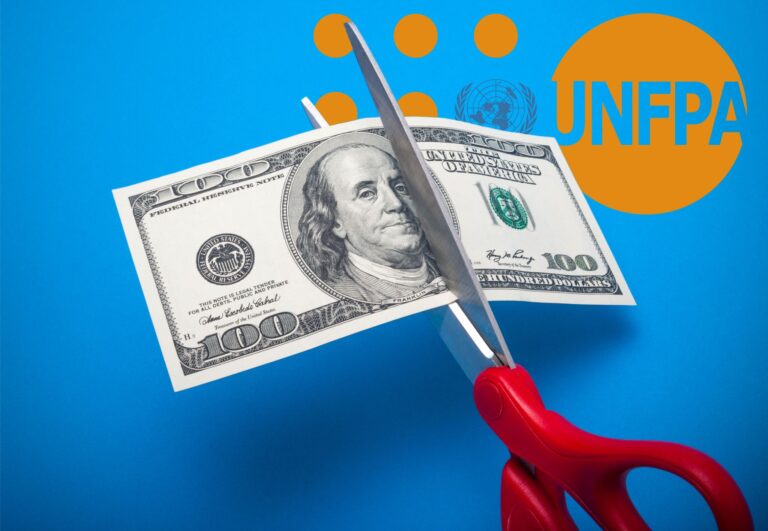

The Philippines is one of the last Christian, Westernized nations where people have enough children to assure the future of their country. Now, the United Nations Population Fund (UNFPA) and other population control agencies have gathered enough fifth column support inside this nation of islands to make a big push for the destruction of that nation. Despite the already dramatic and continuing decline in Filipino family size, the international population controllers and their local collaborators want to make the collective suicide of this Third World nation an official part of her laws and policies. The proposed two-child policy for the Philippines, supported by President Gloria Arroyo, 50 out of 200 Filipino congressmen, and five Filipino senators (so far), includes coercive aspects similar to those found in many other Third World nations’ population control programs. And the bill mandating the two-child policy includes sex education for Filipino children, even though abstinence-based efforts in the Philippines have been remarkably effective in containing the spread of AIDS.
Two-Child Family
The Responsible Parenthood and Population Management Act of 2005 (HB 3773) would officially enshrine two children as the proper family size in the Philippines, where women have 2.8 children over the course of their lifetimes on average. The current total fertility rate of 2.8 children per woman is a huge drop from 6 in 1970, 5 in 1980, and 4 in 1990. Even the pro-population control United Nations Population Division projects that the Filipino fertility rate will continue its long decline, dropping to under 2 by 2030 (replacement rate is 2.1).
That hasn’t stopped Arroyo and others from trying to get the national government involved in telling Filipino families how many children they should have. They claim the bill is not coercive, yet it contains a discriminatory provision right off the bat: Children from families that have more than two kids will be disfavored for college scholarships. Children from families with one or two kids will be preferred, “Children from these families shall have preference in the grant of scholarships at the tertiary level taking into consideration the financial need and academic aptitude of the grantees,” says the bill.
“I’m trying to put together a group in the United States of Filipino-Americans to support leaders in the Philippines organizing grassroots efforts against this bill,” said Philippines-born Eileen Macapanas Cosby, who has founded the Filipino Family Fund for this purpose. Among other efforts, the Fund is circulating a letter to members of the Filipino Congress opposing the bill. Cosby spoke to a group of 2,000 Filipino-Americans at the National Shrine in Washington, D.C., and is distributing flyers about the bill in heavily Filipino areas and parishes. In the Philippines, “the Catholic Church is the biggest voice against this,” she said.
Time is Short
Time is short. The bill is scheduled for a vote this year, though impeachment proceedings against the allegedly corrupt Arroyo and other political turmoil could delay the vote.
The bill mandates a “population officer” for each local district in the Philippines, and you can be sure that such officers, especially in remote rural areas, will employ vigorous methods to please their superiors by hitting population control goals. That has been the experience in other countries with such numerical goals, such as China and India. Already, the Filipino Catholic bishops’ conference has documented coercion of Filipina women in the country’s current family planning efforts, including a case of a woman who had an IUD inserted without her knowledge.
Just this past February, in a ceremony with the Philippines’ ambassador to the UN, UNFPA promised $26 million through 2009 for Filipino population control efforts. UNFPA’s Philippines page has links to articles promoting HB 3773. As usual, UNFPA is working hand-in-glove with domestic leaders in a Third World country to promote its anti-population agenda.
HB 37773, a clearly anti-Catholic piece of legislation, coerces Christian schools and health care workers. Catholic schools would be forced to teach sex education if this bill became law, and sex education includes information about condoms and other contraceptives. Health care workers who refuse to perform sterilizations or dispense contraceptives — probably including the abortifacient morning-after pill — could face six months in jail. Pro-life Catholic doctors and nurses would be forced to violate their consciences or be driven from their professions.
Abstinence-Based Approach
The Filipino approach, typified by Dr. Rene Bullecer and his Coalition for an Aids-Free Philippines has kept the Philippines relatively free of HIV infection. The adult HIV infection rate was a mere 0.1% in 2001, though the Philippines has a low condom-use rate. Even Arroyo ascribed this success to “good morality.” Yet results don’t matter: The bill adopts the pro-“safe” sex approach that has failed everywhere. The bill, echoing the language of international bureaucrats, makes vague statements such as, “The State likewise guarantees universal access to safe, affordable and quality reproductive health care services, methods, devices and relevant information thereon even as it prioritizes the needs of women and children, among other underprivileged sectors.” “Reproductive health care services” is often interpreted to include abortion, though this bill specifically says that it does not affect the Philippines’ anti-abortion law. But as our founder, Fr. Paul Marx, is fond of saying, “Contraception always leads to abortion.”
A letter opposing HB 3773 to congressmen from the Philippines Alliance for the Family Foundation Philippines (ALFI) explains: “It is also not true that widespread use of contraceptives will reduce illegal abortions. In every single country where contraceptives became widely available, abortions increased. This is because women will still get pregnant unexpectedly. When they have the mentality that a new birth is unwanted, they turn to abortion as back-up for contraceptive failure. For instance, 54% of American women who had an abortion were using contraception when they became pregnant; one in three women has had at least one abortion in their lifetime. Yet the contraceptive prevalence rate in the United States is over 90%.” The contraceptive mentality, the dedication to no or few children combined with free and easy sexual relations, leads to abortion. HB 3773 also promotes a feminist agenda for the Philippines. “Protection and promotion of gender equality and women’s rights are essential to the fulfillment of reproductive health rights” is a typical passage; others talk about equalizing the rights and responsibilities of men and women. Does that mean men must do half the childrearing, even if they work full-time and their wives don’t? Will the government encourage mothers to work outside the home? Will the Christian family model with the father as head of the household become illegal, or at least disfavored, under the law? “There are more pro-lifers on the ground in the Philippines than pro-choicers,” said Cosby. With the help of the bishops, they stand an excellent chance of turning back the effort to make the dictation of family size government policy in their country.